


In Part 1, we looked at why activity metrics mislead on long agent builds and how to score a build from evidence. In Part 2, we defined Return on Token, showed why rework costs grow quadratically, and explained our three-round review cap. This last part zooms out to the whole build: why tokens spent on design at the start pay back across every task that follows, and why human attention needs its own ledger.
Long-Running Builds Compound Like Discounted Cash Flow
On a 1-task fix, is purely local. On a 50-to-65-task, two-day build where later tasks depend on earlier ones, early tasks compound forward just like capital in a Discounted Cash Flow (DCF) model.
In finance, $1 invested at Period 1 compounds across the remaining 49 periods, , while $1 at Period 50 compounds across zero. Software dependency chains behave much the same way, amplified by :
- Task 1 carries massive downstream reach: Spending extra tokens upfront—on Architecture, locked module contracts, and Stage 1's end-to-end reference slice—looks like a higher upfront cost if you score Task 1 in isolation, just like capital expenditure at .
- The return arrives across Tasks 2 through 65: Clean upstream interfaces drive downstream rework rounds toward
0. Because every downstream task's Return on Token scales with , shaving even0.5rework cycles off 50 dependent tasks pays back the upfront architectural tokens many times over. - Sloppy Task 1 charges compound rework interest: Saving 20% of tokens on Task 1 by skipping interface design forces every downstream worker to fight leaky abstractions, decaying wave after wave until the build stalls out.
- The catch: Task 1 is also where we know the least. The decisions with the most downstream reach get made at the point of greatest uncertainty, before any code has tested them. Software estimation has a name for this, the cone of uncertainty: what you know about a project is weakest at the start and narrows as work lands. So the return on upfront design comes discounted by the odds that the early guess was right, and those odds are lowest exactly where the reach is highest. That's why our extra upfront spend goes into the thin end-to-end slice, the cheapest way to test the early guess against real code, and why workers get savepoints to flag a contract that turns out to be wrong instead of shimming around it.
You can watch that slope directly in real build data. Over the first 55.7 hours of Epic B (65 accepted tasks, +32,178 / -2,119 lines across 339 files), watch what happened to forward efficiency as the foundational contracts and vocabulary standards landed:
- Feature
207.2&207.3(early heavy engine plumbing): η = 61% and 57% (1.64and1.76review cycles/task). - Epic Round 1A (
packet-v2-contracts, 15 tasks): η = 79% (1.27cycles/task). - Epic Round 1B (
vocab-and-construction-plan, 8 tasks): η = 89% (1.12cycles/task,0exceptions).
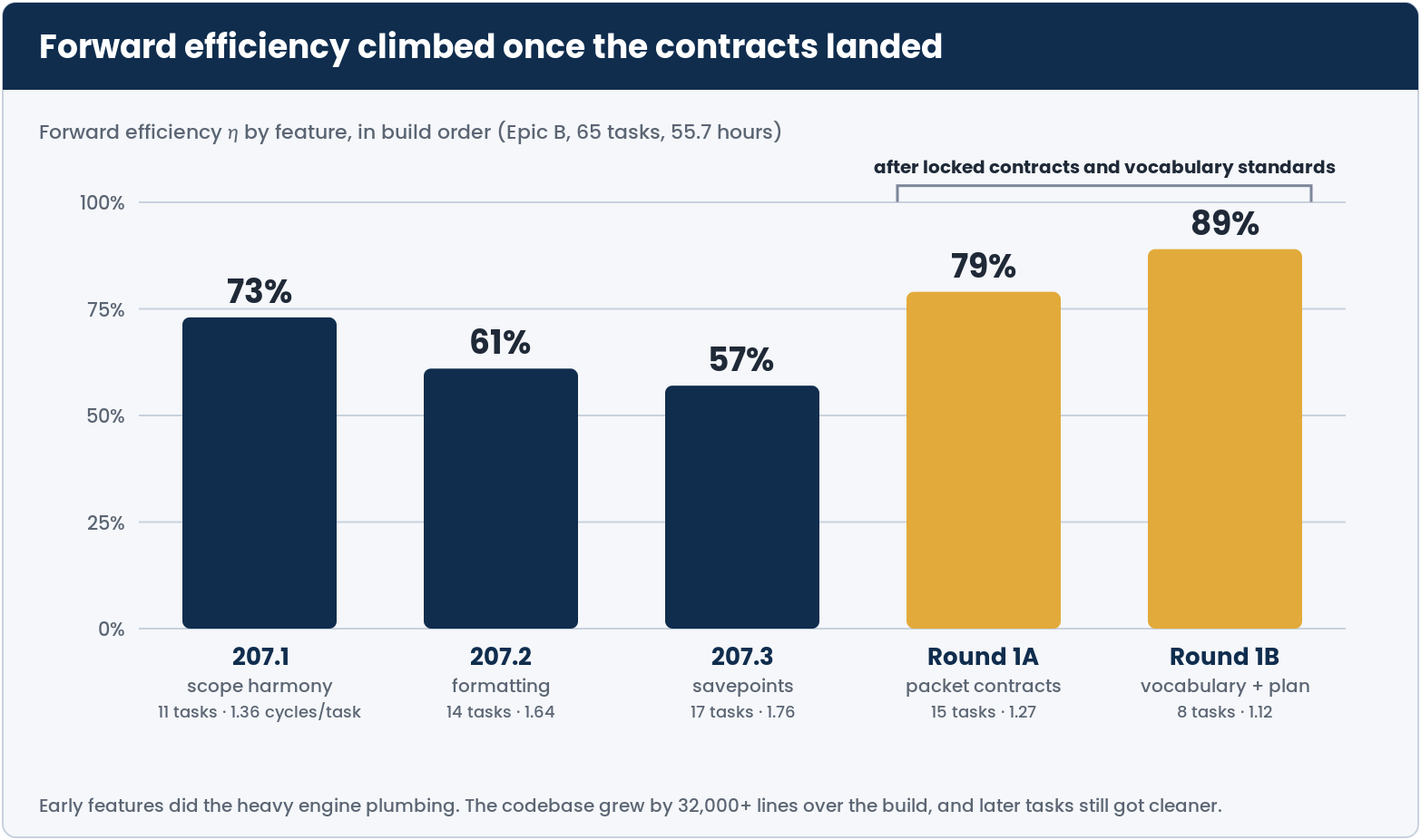
In unconstrained vibe-coding, decays toward zero as a codebase grows. When upfront architectural tokens compound properly, later tasks get easier and cleaner even after adding 32,000+ lines of code.
The Orthogonal Axis: Human Leverage
Keeping human effort out of lets Human Leverage stand clearly on its own axis:
An agent harness can have great token efficiency while interrupting you every four minutes—which destroys human leverage. Or it can leave you alone for eight hours while spinning in circles—which destroys Return on Token. Separating the axes also reveals rational engineering trade-offs: on Feature 207.3, dipped to 57% on tough cross-provider plumbing, yet autonomous runs hit 120.0x per operator input with zero human escalations because agents resolved conflicts autonomously via savepoints (ADR-0049). When senior human attention is scarcer than cached tokens, trading an extra self-healed review cycle for uninterrupted autonomy is a deliberate win.
To push both axes up and to the right simultaneously:
- Collapsing human interruptions: ETC routes worker questions up a four-rung escalation ladder (
worker -> engineering manager -> VP -> human), parks contract conflicts cleanly via savepoints (ADR-0049), and runs a walk-by watchdog every 30 minutes. Across all 5 completed Epic B features (65accepted tasks,38.2active build-task hours across55.7wall-clock hours), ETC executed 783 autonomous worker, check, rework, and judge runs across just 14 scorecard operator inputs—55.9xon average. On the previous 72-task epic, 16 human messages drove roughly 5,000 AI turns, about 830 AI turns per human decision. - Lifting Return on Token simultaneously: Import-graph test selection (
ADR-0011) turns 11-minute full-suite test runs (7,779tests) into targeted few-second runs per task; prompt caching covered 89.2% (224.0Mof251.2M) of recorded judge input tokens across Epic B;ReusedPassand delta diffs cut follow-up judge spend to0.65x; and our architect1–10complexity dial + warm serial worktree reuse cut out the 41-task splice tax.
What ETC Records Today, and What's Next
Our own scorecard rule applies to this series too: never print a fake total when a stream wasn't recorded. ETC 3 records only the review (judge) agents' tokens, inside .etc_sdlc/. The building agents' tokens are logged by the host CLIs (Claude Code, Codex, Grok) in their own local session files, which ETC doesn't read. So every Return on Token figure in this series is judge-side only.
Here is how a build's token cost breaks down today:
- Recorded by ETC (
etc tasks scorecard): every completed task-review judge call, deduplicated by run UUID and including confirmation retries, plus the latest work-level verification judge run per check, such assecurity-review. Follow-up reviews on rework rounds are part of this stream; across Epic B they cost 0.65× of the first review on average. - Not recorded by ETC: planning, the engineering manager's dispatch and rescope turns, and the workers' building turns and rework fixes.
- Free: prompt and feedback compilation (
attempt-<n>.prompt.mdandattempt-<n>.round-<k>.md) is deterministic Python and burns zero LLM tokens.
Two upgrades are next:
- Full cross-role token capture: recording worker execution turns, engineering-manager dispatch and rescope turns, Anthropic
cache_creation_input_tokens, and reasoning-token sub-keys inTokenUsage, soetc tasks scorecardprints both judge-only and full-stack $\mathrm{RoT}{\text{task}}$ and $\mathrm{RoT}{\text{spec}}$ on every PR. - True human attention timers: Distinguishing 90 seconds of active human spec review from overnight wall-clock elapsed time without relying on rough timestamp gaps.
That's the series. We started with a weekend where agents reported 98% step success and shipped about half of their work, and we ended up measuring three things instead: whether the threads of value come out the far end of the tunnel intact, how much rework it took to get them there, and how much human attention it cost. Next, we'll pull the main principles together for technology leaders in one short post.
Appendix: Epic B Rollup
| Feature | Accepted Tasks ($F$) | Verified Criteria ($A$) | Forward Efficiency () | Cycles / Task | Scorecard Inputs | Autonomous Runs | Runs / Input | Active Build Task Hours |
|---|---|---|---|---|---|---|---|---|
207.1 (transactional-scope-harmony) |
11 | 15 / 15 | 73% (11/15) |
1.36 | 3 | 116 | 38.7x | 3.42 h |
207.2 (canonical-formatting-500) |
14 | 24 / 24 | 61% (14/23) |
1.64 | 3 | 189 | 63.0x | 9.00 h |
207.3 (contract-conflict-savepoints) |
17 | 32 / 33* | 57% (17/30) |
1.76 | 2 | 240 | 120.0x | 12.83 h |
packet-v2-contracts (Epic Round 1A) |
15 | 30 / 30 | 79% (15/19) |
1.27 | 3 | 162 | 54.0x | 9.21 h |
vocab-and-construction-plan (Epic Round 1B) |
8 | 26 / 27* | 89% (8/9) |
1.12 | 3 | 76 | 25.3x | 3.74 h |
| 5-Feature Total (Rounds 2–3 still ahead) | 65 | 127 / 129* | 68% (65/96) |
1.48 | 14 | 783 | 55.9x | 38.20 h |
*Publication accuracy footnotes:
- The two unmet criteria in Epic B are recorded, operator-approved debts: 5 pre-existing
>50-line functions in207.3(queued as backlog257–259) and in-sandbox--covbaseline exclusions onvocab-and-construction-plan(where changed-line diff coverage hit100%329/329). - In
ledger.jsonl,9extra person-attributed verify/task-accept approvals appear alongside the14request/go-ahead/answer inputs counted bytasks_scorecard_leverage.py. We left them out of the human-input math on purpose: they weren't judgment calls. The operator was checking in on the work, not making a decision. - Recorded judge token totals across Epic B:
251,247,111input (224,042,810cached =89.2%cache hit rate) and2,036,222output (241.99Min task review rows +9.26Min work-level Verify/Arch judge runs).
AI attribution: 3/4 — Human-originated, AI-shaped. What this means
Jason Vertrees is the founder of Heavy Chain Engineering, which helps lower middle-market vertical SaaS companies and PE firms turn scattered AI usage into measurable delivery leverage — 85% faster feature velocity, six-to-eight-week projects shipped in days. If you want help building an AI-native engineering organization, book an AI Delivery Assessment or email info@heavychain.org.